Book

The Sum of All Kisses (Smythe-Smith Quartet #3) By: Julia Quinn

The Sum of All kisses

The Sum of All Kisses (Smythe-Smith Quartet #3) By: Julia Quinn

Plot:

He thinks she’s an annoying know-it-all…

Hugh Prentice has never had patience for dramatic females, and if Lady Sarah Pleinsworth has ever been acquainted with the words shy or retiring, she’s long since tossed them out the window. Besides, a reckless duel has left this brilliant mathematician with a ruined leg, and now he could never court a woman like Sarah, much less dream of marrying her.

She thinks he’s just plain mad…

Sarah has never forgiven Hugh for the duel he fought that nearly destroyed her family. But even if she could find a way to forgive him, it wouldn’t matter. She doesn’t care that his leg is less than perfect, it’s his personality she can’t abide. But forced to spend a week in close company they discover that first impressions are not always reliable. And when one kiss leads to two, three, and four, the mathematician may lose count, and the lady may, for the first time, find herself speechless … New York Times bestselling author Julia Quinn’s enchanting third novel in the Smythe-Smith quartet is guaranteed to make you laugh out loud and tug at your heartstrings in equal measures.

Review:

It’s been so long since I’ve read a Juilia Quinn book I forgot how much I love her. Historical romances are not a genre I normally enjoy, but she provides just the right amount of detail to set the scene, but not bog me down in how much she knows about the era.

Love the Smythe-Smith’s. It’s been a while, like I said, so I didn’t remember everyone’s name, but it came back quickly. I love how strong her women are and how interconnected the universe is, all of her books seem to connect, even if it’s just in passing.

Sarah and Hugh were wonderful and I’m not just saying that because they remind me of my husband and I. Great romance, great personalities.

It did get a little wonky, reasoning wise, at the very end, but it ended up making sense. Sense enough for a romance.

Really loved this and so glad that I already have the next one ready to read.

5/5

The Happiest Toddler on the Block: The New Way to Stop the Daily Battle of Wills and Raise a Secure and Well-Behaved One-to Four-Year-Old By: Harvey Karp & Paula Spencer

Happiest Toddler

The Happiest Toddler on the Block: The New Way to Stop the Daily Battle of Wills and Raise a Secure and Well-Behaved One-to Four-Year-Old By: Harvey Karp & Paula Spencer

Synopsis:

Toddlers can drive you bonkers…so adorable and fun one minute…so stubborn and demanding the next! Yet, as unbelievable as it sounds, there is a way to turn the daily stream of “nos” and “don’ts” into “yeses” and hugs…if you know how to speak your toddler’s language. In one of the most useful advances in parenting techniques of the past twenty-five years, Dr. Karp reveals that toddlers, with their immature brains and stormy outbursts, should be thought of not as pint-size people but as pintsize…cavemen. Having noticed that the usual techniques often failed to calm crying toddlers, Dr. Karp discovered that the key to effective communication was to speak to them in their own primitive language. When he did, suddenly he was able to soothe their outbursts almost every time! This amazing success led him to the realization that children between the ages of one and four go through four stages of “evolutionary” growth, each linked to the development of the brain, and each echoing a step in prehistoric humankind’s journey to civilization: – The “Charming Chimp-Child” (12 to 18 months): Wobbles around on two legs, grabs everything in reach, plays a nonstop game of “monkey see monkey do.” – The “Knee-High Neanderthal” (18 to 24 months): Strong-willed, fun-loving, messy, with a vocabulary of about thirty words, the favorites being “no” and “mine.” – The “Clever Caveman” (24 to 36 months): Just beginning to learn how to share, make friends, take turns, and use the potty. – The “Versatile Villager” (36 to 48 months): Loves to tell stories, sing songs and dance, while trying hard to behave. To speak to these children, Dr. Karp has developed two extraordinarily effective techniques: 1) The “fast food” rule–restating what your child has said to make sure you got it right; 2) The four-step rule–using gesture, repetition, simplicity, and tone to help your irate Stone-Ager be happy again. Once you’ve mastered “toddler-ese,” you will be ready to apply behavioral techniques specific to each stage of your child’s development, such as teaching patience and calm, doing time-outs (and time-ins), praise through “gossiping,” and many other strategies. Then all the major challenges of the toddler years–including separation anxiety, sibling rivalry, toilet training, night fears, sleep problems, picky eating, biting and hitting, medicine taking “– “can be handled in a way that will make your toddler feel understood. The result: fewer tantrums, less yelling, and, best of all, more happy, loving time for you and your child.

Review:

I really enjoyed the Happiest Baby on the Block and even though several reviews said this one wasn’t as good I thought I’d give it a try.

There was a ton of repetition in the book, just like Happiest Baby, and it felt like every chapter we were going over the same thing. Part of that is the jargon that he uses throughout. Karp has come up with his own terms for things and uses them constantly.

My husband and I found it difficult to use baby talk when our daughter was smaller and I’m finding it impossible to use the “toddlerese” that he highly recommends. It has so far had no affect on my daughter other than to have her look at me like I’m an idiot.

I was also really concerned about his time out recommendations. If a child is under the age of two he recommends putting them in a play pen for time out. I’m unwilling to do that because we do a lot of traveling and I don’t want her to associate punishment with her play pen. When a child is older than two he says to lock them in a room by themselves, a minute for each year old (2 years, 2 minutes). Right after he says that in the book Karp tries to explain his reasoning, but it did not make me feel any better about the idea.

I have no plans to spank my daughter, but neither do I plan on locking her alone in a room, even if it is a short amount of time.

Overall, I was not impressed by this book. He had several recommendations on how to handle a toddler, but no real recommendations on how to help a parent dealing with a toddler. Sure I can try speaking to her like a caveman but first I have to calm myself down. I did kind of like the idea of growling, but I guess that’s just my primitive side showing.

2/5

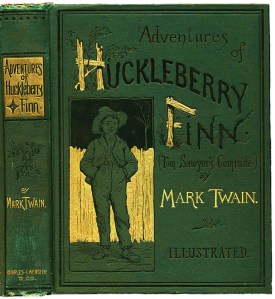
The Adventures of Huckleberry Finn By: Mark Twain

Sadly not the edition I read

Sadly not the edition I read

The Adventures of Huckleberry Finn By: Mark Twain

Plot:

Of all the contenders for the title of The Great American Novel, none has a better claim than The Adventures of Huckleberry Finn. Intended at first as a simple story of a boy’s adventures in the Mississippi Valley – a sequel to The Adventures of Tom Sawyer – the book grew and matured under Twain’s hand into a work of immeasurable richness and complexity. More than a century after its publication, the critical debate over the symbolic significance of Huck’s and Jim’s voyage is still fresh, and it remains a major work that can be enjoyed at many levels: as an incomparable adventure story and as a classic of American humor.

Review:

This is the first book in my list of Classics I Should Read, as well as the oldest books on my to read pile. This year I’ve been trying to read more classics, non-fiction, and whittle down my to read pile. It’s taken a while but I’m finally getting there. There are just so many books!

The next time I hear someone say kids today are violent I’m going to point them in the direction of Huckleberry Finn. The very beginning of the book is Tom Sawyer and Huck Finn along with several other boys deciding they were going to be bandits and kill and steal from people. And if anyone was a rat their whole family would be killed.

The language was great, though at time hard to keep up with. It added another stop on my time travel vacation (the vacation I’ll take when I gain access to a time machine), I would love to hear Mark Twain read one of his stories. I bet it’s amazing.

I loved the first third or so, when it was just Huck and Jim. They got into scrapes and Huck had an interesting point of view on things. When the duke and the king joined them I didn’t find it as fun. They were conmen, to an extent so was Huck, but they were greedy. I was glad when he was finally free of them but what they did to Jim sucked. Then Tom Sawyer had to show up and cock things up again.

Everything was tied up by the end, which I always enjoy, but ultimately I only really liked reading the first third of the book. That’s not fair, I did laugh a couple times at the end with Tom Sawyer and his hijacks.

3.5/5

Side note: Symbolism is lost on me so I’m sure I missed some stuff.


Please Don’t Tell My Parents I’m a Supervillain By: Richard Roberts

Please Dont Tell My Paren'ts I'm a Supervillain

Please Don’t Tell My Parents I’m a Supervillain (Please Don’t Tell My Parents #1) By: Richard Roberts

Plot:

Penelope Akk wants to be a superhero. She’s got superhero parents. She’s got the ultimate mad science power, filling her life with crazy gadgets even she doesn’t understand. She has two super powered best friends. In middle school, the line between good and evil looks clear. In real life, nothing is that clear. All it takes is one hero’s sidekick picking a fight, and Penny and her friends are labeled supervillains. In the process, Penny learns a hard lesson about villainy: She’s good at it. Criminal masterminds, heroes in power armor, bottles of dragon blood, alien war drones, shape shifters and ghosts, no matter what the super powered world throws at her, Penny and her friends come out on top. They have to. If she can keep winning, maybe she can clear her name before her mom and dad find out.

Review:

With a title like that I had to at least read the sample. After a sample like that I had to at least read the book. After a book like that I have to read the next. Notice a theme?

I was nicely surprised by PDTMPIASV, it could have very easily been over the top cheesy with no plot or character development in sight, but it didn’t take the easy way out. There was certainly cheese and it was set over a couple of weeks so there wasn’t much character development, but it was still there and combined with the plot and world it made a great book.

The book was very long for a juvenile fiction book, possibly even for a YA. There were times when it did drag a little, because Roberts wanted to show you that Penny was a normal middle school girl, who just happened to find out that she made a good supervilian. Normal middle school girls are pretty boring.

I did wish that she had found a way to cement herself as a superhero and not just someone who worked both sides. If Roberts was trying to say something more there he didn’t do it clearly enough for me. I did however see why Penny would enjoy being a villain.

I thought her parents were very stupid, especially for supposedly being two of the smartest people on the planet, because of that I doubted everything they said. Obviously this would appeal to kids, she’s pulling something over her parents so easily. As a parent I’m annoyed, though.

If you happen to have a child in the YA/ juvenile fiction age bracket that loves to read I would highly recommend. Because of the length I’m not sure I would recommend for all readers in that age group, though.

4/5

Mockingbird (Miriam Black #2) By: Chuck Wendig

mockingbird

Mockingbird (Miriam Black #2) By: Chuck Wendig

Plot:

Miriam is trying. Really, she is.    But this whole “settling down thing” that Louis has going for her just isn’t working out. She lives on Long Beach Island all year around. Her home is a run-down double-wide trailer. She works at a grocery store as a check-out girl. And her relationship with Louis–who’s on the road half the time in his truck–is subject to the piss and vinegar Miriam brings to everything she does.    It just isn’t going well. Still, she’s keeping her psychic ability–to see when and how someone is going to die just by touching them–in check. But even that feels wrong somehow. Like she’s keeping a tornado stoppered up in a tiny bottle.    Then comes one bad day that turns it all on her ear.

Review:

Miriam does not do normal, at all. So when she tries to be normal for Louis it does not work and I really feel like she acted even more outrageous than she would have if she hadn’t been suppressed for so long. Louis didn’t seem like he was conscientiously trying to change Miriam, it was more like she felt obligated to try since she’d got his eye poked out.

This series is much darker than I normally read but I still like it. Definitely not something I could read a lot of all at once, but it’s nice to change things up every now and then. Wendig writes great characters and his women are not the damsel in distress sort. He tells his story from a unique perspective, and even though I really don’t like Miriam, I can’t help but hope she succeeds and figures her life out.

4/5